China–UAE Trade Routes and Port Guide: Ningbo, Shanghai, Shenzhen, Qingdao to Jebel Ali
Which Chinese port your cargo leaves from, and which route it takes to get to the UAE, shapes almost everything downstream: transit time, cost, carrier options, and how much flexibility you have if something goes wrong mid-shipment. Importers who default to whichever port their supplier happens to use often leave money and time on the table, especially once cargo volume grows large enough to justify comparing options.
This guide maps the main routes that connect China's largest export hubs, Shanghai, Ningbo, Shenzhen, and Qingdao, to Jebel Ali, the UAE's primary container gateway. It covers how each Chinese port differs, what Jebel Ali offers as a destination, the difference between direct and transshipment routings, and how to match a route to your specific cargo type, whether that's standard containerized freight, dangerous goods, ISO tank containers, or breakbulk and project cargo.
The Complete Guide to Shipping from China to the UAE
Key Takeaways
- Shanghai, Ningbo, Shenzhen, and Qingdao each serve different cargo profiles and regional manufacturing bases, so the "best" origin port depends on where your goods are produced and what you're shipping, not a single universal ranking.
- Jebel Ali is the dominant UAE destination for containerized, RoRo, breakbulk, and project cargo from China, but it isn't the only viable UAE port for every cargo type.
- Direct sailings are generally faster than routings that transship through a hub port, but they aren't always available for every origin-destination pair or cost-competitive for every cargo volume.
- Dangerous goods, ISO tank containers, and breakbulk or project cargo each have routing constraints, such as vessel dangerous goods quotas or lift capacity, that standard containerized cargo doesn't.
- Route selection should weigh transit time, cost, service frequency, and cargo-specific handling requirements together, not transit time alone.
- Port congestion and capacity conditions shift over time, so a route that worked well last shipping season is worth re-checking before you commit to it again.
In This Guide
This pillar article gives a full overview of China–UAE port and route selection. The related articles below go deeper into specific decisions and scenarios:
- How to Choose the Right Chinese Port for Your UAE-Bound Cargo
- Ningbo to Jebel Ali: Transit Times, Costs, and Route Options
- 5 Mistakes Exporters Make Choosing a China–UAE Shipping Route
- Shanghai vs Ningbo: Which Port Is Better for UAE Chemical Imports
- Jebel Ali Port Regulations and Berthing Requirements for China Imports
- Port-to-Port Documentation Checklist for China–UAE Ocean Freight
- Case Study: Rerouting a Shenzhen Shipment During Peak Season Congestion
- China–UAE Port Routing FAQ: Transit Times, Transshipment, and Delays
- Port Congestion and Capacity Trends on the China–UAE Corridor in 2026
Why Route Selection Deserves More Attention Than It Usually Gets
Most importers treat the shipping route as a fixed variable set by whichever supplier or forwarder handled the last order. That's a reasonable default for a single small shipment, but it stops being a good default once volume, cargo variety, or cost sensitivity increases.
The route determines which carriers and sailing frequencies are available to you, how much exposure you have to transshipment delays, and in some cases which UAE port your cargo actually lands at. For standard general cargo, the differences between a well-chosen and poorly-chosen route might be a few days and a modest cost delta. For dangerous goods, ISO tank containers, or breakbulk and project cargo, the differences can be larger, because not every route, vessel, or port handles those cargo types equally well.
Overview of the Major Chinese Export Ports
China's coastline hosts several of the world's busiest container ports, and four of them handle the bulk of cargo moving toward the UAE and the wider Gulf region: Shanghai, Ningbo, Shenzhen, and Qingdao. Each sits in a different manufacturing region and has a somewhat different cargo mix, which matters more than most importers realize when choosing where to route a shipment.
Shanghai
Shanghai is China's largest port by volume and serves the manufacturing base of the Yangtze River Delta, one of the country's most diversified industrial regions. It handles everything from consumer electronics and machinery to chemicals and general merchandise, and it typically offers a wide range of direct and transshipment sailing options toward the Middle East. For importers sourcing from multiple factories across eastern and central China, Shanghai is often the port where cargo consolidates before departure, simply because so many inland supply chains feed into it.
Ningbo
Ningbo, also on the Yangtze Delta and close to Shanghai geographically, has grown into one of the world's highest-volume ports in its own right. It's a strong option for cargo originating from Zhejiang province manufacturers and can offer competitive routing to Jebel Ali, sometimes with less port congestion than Shanghai during peak periods, though that varies by season and by year. Ningbo also handles a meaningful volume of chemical and bulk liquid cargo, which is relevant for shippers moving goods in ISO tank containers.
Shanghai vs Ningbo: Which Port Is Better for UAE Chemical Imports
Shenzhen
Shenzhen, in the Pearl River Delta near Hong Kong, serves South China's electronics, consumer goods, and light manufacturing base. It's frequently the natural origin point for importers sourcing from Guangdong-based suppliers, and it offers strong connectivity for containerized cargo. Shenzhen's port complex includes multiple terminals with different operators, which can affect which specific terminal your cargo departs from and how that interacts with your forwarder's booking relationships.
Qingdao
Qingdao, further north on the Shandong peninsula, serves a manufacturing base that includes machinery, chemicals, and heavier industrial goods alongside general cargo. It's a relevant origin port for importers sourcing from northern China, and it has notable capacity for bulk and project cargo alongside standard containerized freight, which makes it worth considering for breakbulk shipments originating from that region.
How to Choose the Right Chinese Port for Your UAE-Bound Cargo
Jebel Ali: The UAE's Primary Gateway
Jebel Ali, part of the Dubai port system operated by DP World, is the main destination port for China-origin cargo entering the UAE. It functions both as an import gateway for goods consumed within the UAE and as a re-export and transshipment hub serving the wider GCC and, in some cases, onward markets in East Africa and South Asia.
A few characteristics make Jebel Ali the default choice for most China–UAE routings. It has deep-water berths capable of handling large container vessels, extensive terminal capacity across multiple operators, and free zone status that simplifies certain re-export and bonded storage scenarios. It also has established handling capability across cargo types beyond standard containers, including RoRo ramps for wheeled cargo and heavy-lift capacity for breakbulk and project cargo, which matters for importers moving anything beyond general merchandise.
Jebel Ali Port Regulations and Berthing Requirements for China Imports
Other UAE Ports Worth Knowing About
Jebel Ali handles the large majority of containerized China-origin cargo, but it isn't the only UAE port in play. Depending on final destination within the UAE, cargo type, and specific free zone requirements, other ports, including facilities in Abu Dhabi and Sharjah, can be more efficient for certain shipments. This is a routing decision worth raising with your forwarder rather than assuming Jebel Ali by default, particularly for cargo destined for northern Emirates or for shippers with existing bonded warehouse arrangements elsewhere.
Direct Sailings vs Transshipment Routings
Cargo moving from China to the UAE either travels on a direct service, calling at the Chinese origin port and Jebel Ali with no intermediate port calls, or it transships through a hub port, typically somewhere along the Indian subcontinent or in Southeast Asia, where it's transferred to a different vessel for the final leg to Jebel Ali.
Direct Sailings
A direct sailing generally offers the fastest and most predictable transit time, since the cargo stays on one vessel for the entire ocean leg and avoids the handling risk and scheduling dependency that comes with a mid-voyage transfer. Direct services aren't available from every Chinese port on every sailing week, though, and carrier capacity on direct routes can tighten during peak shipping seasons.
Transshipment Routings
A transshipment routing adds at least one intermediate port call and cargo transfer, which introduces additional transit time and an additional point where a delay, whether from the connecting vessel's schedule or from congestion at the transshipment port itself, can push back your overall arrival date. Transshipment routings are often more available and sometimes more cost-competitive than direct sailings, particularly for origin ports or cargo volumes that don't support a dedicated direct service.
Neither option is universally better. A direct sailing that runs at a lower frequency, say once every two or three weeks, might actually deliver worse overall lead time than a transshipment routing with weekly departures, depending on when your cargo is ready to ship relative to the sailing schedule.
What Actually Affects Transit Time
Transit time on this corridor depends on more than the straight-line distance between the origin and destination ports. Several factors interact to determine how long a shipment actually takes door to door.
Origin Port and Vessel Scheduling
Sailing frequency from your specific origin port matters as much as the advertised transit time for a given service. A port with daily or near-daily departures gives you more flexibility to hit a target ship date than one with only weekly or biweekly sailings.
Routing Type
As covered above, direct sailings typically move faster than transshipment routings, though the gap varies by specific route and by how efficiently the transshipment port is operating at the time of shipment.
Seasonal Demand and Congestion
Volume on the China–UAE corridor isn't constant throughout the year. Periods of elevated demand, whether tied to manufacturing cycles, holiday shipping patterns, or broader trade conditions, can strain vessel capacity and port throughput, which extends both booking lead times and actual transit times.
Port Congestion and Capacity Trends on the China–UAE Corridor in 2026
Cargo Type
Dangerous goods, ISO tank containers, and breakbulk or project cargo can all face additional scheduling constraints that standard containerized cargo doesn't, which is covered in more detail below.
Choosing the Right Port and Route for Your Cargo
There's no single best China–UAE route. The right choice depends on where your goods are manufactured, what you're shipping, how urgent the timeline is, and what your cost priorities are.
Start With Where Your Goods Are Made
The most efficient origin port is usually the one closest to your supplier's factory or your consolidation point, since inland trucking or rail costs and transit time to the port add up before the ocean leg even begins. Routing cargo to a distant port to chase a marginally better ocean rate can end up costing more once inland transport is factored in.
Match the Route to Your Cargo Type
Standard containerized general cargo has the most routing flexibility, since it can move on nearly any service from any of the four major ports. Cargo-specific constraints narrow the field for other categories, covered in the next section.
Weigh Cost Against Speed
A faster, direct routing typically carries a rate premium over a slower transshipment option, though not always, since pricing depends on current carrier capacity and demand on each specific route. Whether the premium is worth paying depends on how time-sensitive the shipment actually is.
Consider Service Frequency, Not Just Advertised Transit Time
A route with a shorter advertised transit time but infrequent sailings can produce a longer real-world lead time than a route with a slightly longer transit time but weekly departures, especially if your cargo readiness date doesn't align neatly with the low-frequency service's sailing schedule.
5 Mistakes Exporters Make Choosing a China–UAE Shipping Route
Route Considerations by Cargo Type
Standard containerized cargo aside, several cargo categories that Farway specializes in have routing constraints worth understanding before you commit to a specific origin port or sailing.
Dangerous Goods
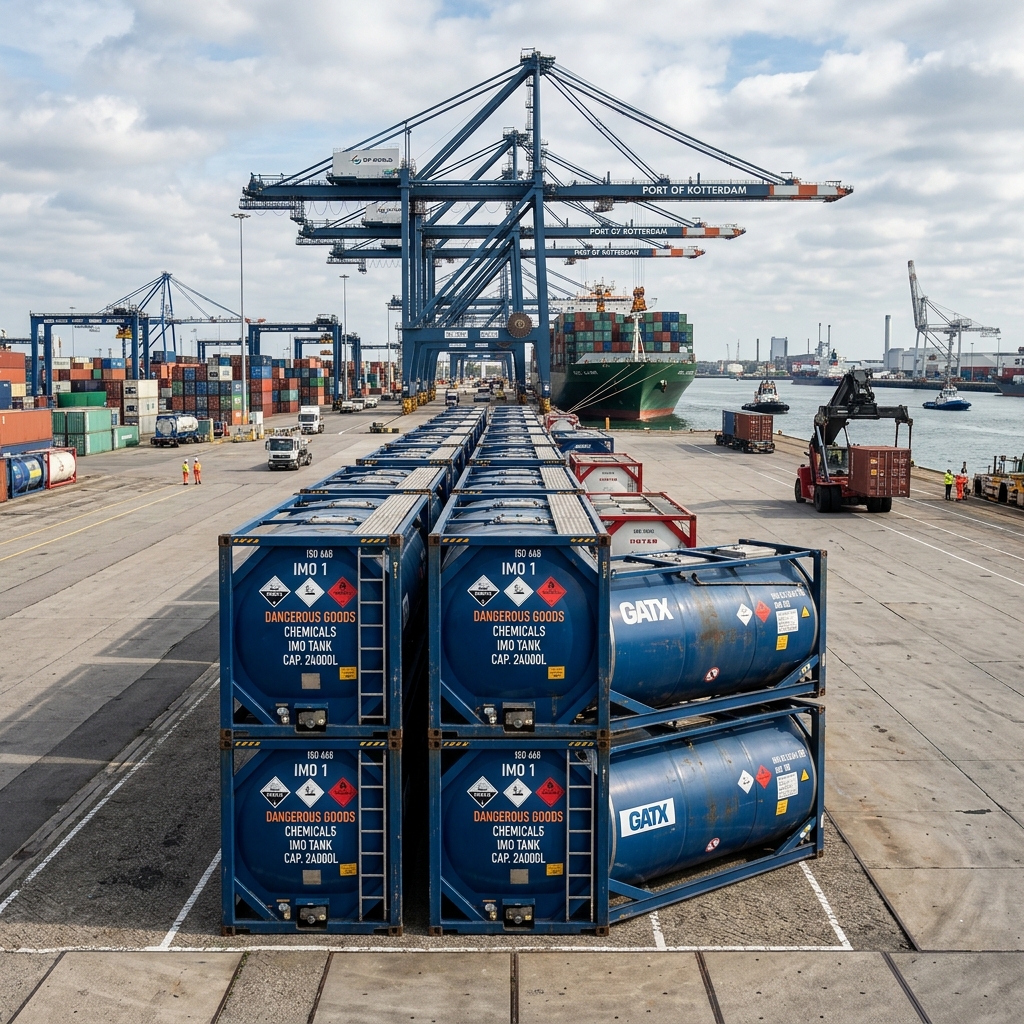
Not every vessel accepts dangerous goods, and those that do have quotas on how much of a given IMDG class they'll carry on a specific voyage. This means the fastest or cheapest available sailing on a given route isn't automatically available for a dangerous goods shipment, and booking needs to happen with enough lead time to confirm space and stowage compatibility. Origin port choice can also matter here, since not every port has equal capacity for dangerous goods handling and storage ahead of loading.
ISO Tank Containers
Tank container availability, and the ability to source a tank with the right lining and prior-cargo compatibility for your product, varies by region within China. Ningbo and Shanghai, given their chemical and bulk liquid cargo volumes, tend to have stronger tank container infrastructure than some other origin ports, which is a practical factor in route selection for shippers moving liquids or gases.
RoRo Cargo
Vehicles and other wheeled or self-propelled cargo depend on RoRo vessel schedules, which run less frequently than standard container services and can have tighter capacity during peak periods. RoRo routing decisions often need to be made further in advance than a standard container booking.
Breakbulk and Project Cargo
Oversized and non-containerizable cargo needs a port and vessel with the lift capacity, deck space, or ramp access the specific cargo requires. Not every routing option can handle every project cargo configuration, so this category typically needs to be planned around available heavy-lift or project vessel schedules rather than fit into a standard container routing.
Port-to-Port Documentation Checklist for China–UAE Ocean Freight
Documentation and Customs Considerations Across Routes
Route choice affects more than transit time and cost. It also touches which port pair your documentation needs to reference, how transshipment affects bill of lading and customs paperwork, and how quickly UAE customs clearance can proceed once cargo arrives.
A transshipment routing typically requires the bill of lading and related documents to correctly reflect the full voyage, including the transshipment port, which needs to match what's declared at both export and import. Errors here, such as a bill of lading that doesn't clearly show the full routing, can create clearance friction at Jebel Ali even when the underlying cargo and commercial documents are otherwise correct.
Port-to-Port Documentation Checklist for China–UAE Ocean Freight
An in-house UAE customs clearance and manifestation capability, rather than a third-party clearing agent handoff, can shorten the loop when a routing-related document discrepancy needs to be resolved quickly, since the same team that booked the freight also handles the clearance filing.
A Real-World Example: When Routing Has to Change Mid-Shipment
Route planning doesn't always go according to the original booking. Port congestion, vessel schedule changes, or capacity constraints on a specific service can force a rerouting decision after cargo has already left the factory, which tests how well a forwarder can adapt without losing days in the process.
Case Study: Rerouting a Shenzhen Shipment During Peak Season Congestion
Common Routing Mistakes Exporters and Importers Make
Even experienced shippers make avoidable routing errors on this corridor. The most common ones include defaulting to the same origin port and routing regardless of where the goods are actually manufactured, booking dangerous goods or project cargo too close to the sailing date without confirming vessel capacity, ignoring service frequency in favor of the lowest advertised transit time, and failing to revisit routing decisions when port congestion or capacity conditions shift from one shipping season to the next.
5 Mistakes Exporters Make Choosing a China–UAE Shipping Route
Port Congestion and Capacity: A Moving Target
Route and port conditions on the China–UAE corridor aren't static. Congestion at a specific Chinese port, capacity constraints at Jebel Ali during peak periods, or broader shifts in vessel deployment can all change which routing makes sense from one quarter to the next. A route that was the clear best option last year isn't guaranteed to still be the best option today, which is why route selection benefits from an ongoing conversation with your forwarder rather than a one-time decision.
Port Congestion and Capacity Trends on the China–UAE Corridor in 2026
Frequently Asked Questions
Which Chinese port is best for shipping to the UAE?
There isn't a single best port for every shipper. The right choice depends on where your goods are manufactured, your cargo type, and whether a direct or transshipment routing suits your timeline and budget. Shanghai and Ningbo tend to offer strong connectivity for general and chemical cargo, Shenzhen suits electronics and consumer goods from South China, and Qingdao is relevant for northern China manufacturing and some breakbulk cargo.
Is a direct sailing always faster than a transshipment routing?
Usually, but not always. A direct sailing typically has a shorter advertised transit time, but a lower sailing frequency can offset that advantage in practice. A transshipment routing with weekly departures might deliver a comparable or better real-world lead time than a direct service that only sails every few weeks.
Does Jebel Ali handle all types of China-origin cargo?
Jebel Ali handles the large majority of containerized, RoRo, breakbulk, and project cargo arriving from China, but other UAE ports can be more efficient for specific cargo types or final destinations within the UAE. This is worth discussing with your forwarder rather than assuming Jebel Ali by default.
How far in advance should I book a dangerous goods or project cargo shipment?
Earlier than a standard container booking. Dangerous goods shipments depend on vessel quotas and stowage compatibility that need to be confirmed ahead of the sailing, and project cargo depends on lift capacity and berth availability that isn't guaranteed on every service. Your forwarder can advise on realistic lead times for your specific cargo and route.
China–UAE Port Routing FAQ: Transit Times, Transshipment, and Delays
Conclusion: Treat Routing as an Active Decision, Not a Default
The route your cargo takes from China to the UAE affects cost, transit time, and reliability more than most importers give it credit for. Matching the origin port to where your goods are actually made, understanding when a direct sailing is worth its premium, and accounting for the specific constraints that dangerous goods, ISO tank containers, and breakbulk or project cargo bring to routing decisions all add up to fewer surprises and fewer avoidable delays.
If you're planning a China–UAE shipment and want a routing recommendation based on your specific cargo, origin port, and timeline, Farway's team manages freight and in-house UAE customs clearance through Jebel Ali across all of these cargo types.
Ready to move forward? [Request a cargo assessment](/contact or quote request page)