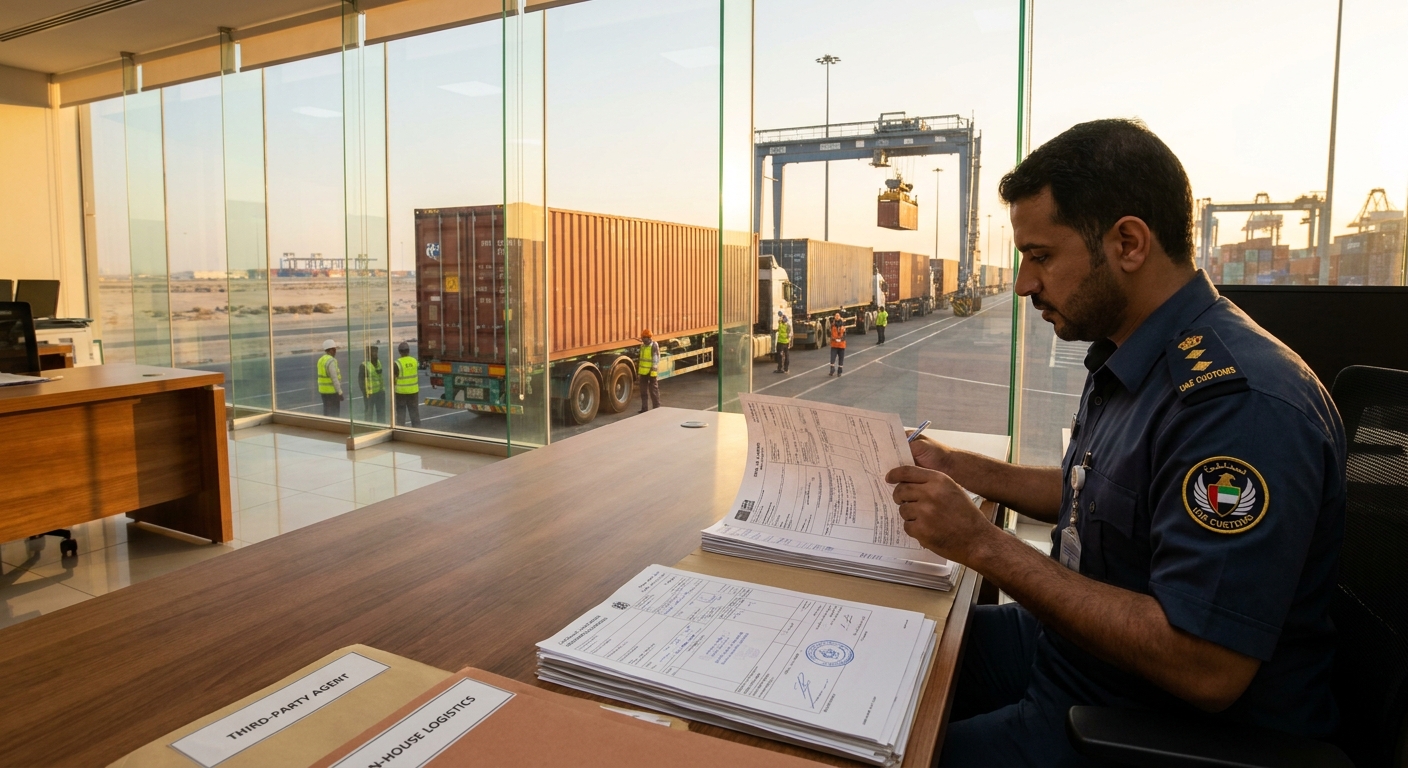
In-House Customs Clearance vs Third-Party Agents: Which Forwarder Model Wins
Every China–UAE freight forwarder handles customs clearance one of two ways: with an in-house team that manages clearance and manifestation directly, or by outsourcing that work to a separate third-party clearing agent once cargo arrives at a UAE port. The distinction rarely comes up as the headline feature in a sales pitch, but it's one of the most predictive factors for how smoothly your shipments actually clear customs, especially when something needs to be fixed quickly.
How to Choose a China–UAE Freight Forwarder: A Buyer's Guide
This comparison lays out how each model actually works, where each one performs better, and what questions to ask a forwarder to find out which model you're getting.
Key Takeaways
- In-house clearance keeps freight booking and customs filing under one accountable team, which generally shortens the loop when a document needs correcting.
- Third-party clearance adds a coordination step between the forwarder and the agent, which can slow down status updates and issue resolution.
- Cost structures differ: in-house models often price clearance as part of an integrated fee, while third-party models pass through a separate agent invoice, sometimes with a coordination markup.
- Neither model guarantees good service on its own; a well-run third-party relationship can outperform a poorly run in-house team, but the structural advantage favors in-house for speed and accountability.
- Ask a forwarder directly which model they use, and how they handle a clearance issue end to end, before assuming.
How In-House Customs Clearance Works
With an in-house model, the same company that books your freight and prepares your shipping documentation also holds the customs registration to file the import declaration, manage the manifest, and coordinate directly with UAE customs authorities at the port of arrival. The team handling your freight has full visibility into the shipment's history, so when a document needs correcting or a valuation question comes up, the person resolving it already has the context.
How the Third-Party Agent Model Works
With a third-party model, the forwarder books and manages the freight, then hands the shipment off to a separate customs clearing agent once it arrives in the UAE. The agent files the import declaration and manages clearance, then reports status back to the forwarder, who relays it to you. This model can work well when the agent is experienced and responsive, but it introduces an additional party, and an additional communication link, into the process.
Speed: How Each Model Handles a Clearance Issue
This is where the practical difference between the two models shows up most clearly. When a document needs correcting or a shipment is flagged for inspection under an in-house model, the team that has the full shipment history can act directly, often within the same conversation. Under a third-party model, the forwarder first has to relay the issue to the agent, wait for the agent's assessment, and relay the resolution back, and each step in that relay is a place where information can lag or get miscommunicated.
Accountability: Who's Responsible When Something Goes Wrong
Under an in-house model, accountability is straightforward: the forwarder who booked your freight is also responsible for the clearance outcome. Under a third-party model, accountability can blur between the forwarder and the agent, particularly if a delay or error is disputed. Some third-party relationships are managed well enough that this rarely becomes an issue, but it requires the forwarder to actively manage the agent relationship on your behalf, which not every forwarder does with the same rigor.
China–UAE Freight Forwarder FAQ: Contracts, Liability, and SLAs
Cost: How Pricing Differs Between the Two Models
An in-house model typically bundles clearance into an integrated service fee, which tends to make total cost more predictable since the forwarder controls the entire pricing structure. A third-party model passes through the clearing agent's separate invoice, and depending on the forwarder, may add a coordination fee on top. This doesn't automatically make third-party clearance more expensive, but it does add a variable that's harder to predict in advance.
Where a Third-Party Model Can Still Work Well
A well-managed third-party relationship, where the forwarder maintains a long-standing, closely coordinated partnership with a specific clearing agent, can perform close to an in-house model in practice. The structural risk is lower when the forwarder treats the agent as an extension of their own team rather than a disconnected vendor, with shared systems and regular communication. This is worth asking about directly rather than assuming every third-party arrangement carries the same risk.
Comparison Summary
| Factor | In-House Clearance | Third-Party Agent |
|---|---|---|
| Issue resolution speed | Generally faster; same team handles booking and clearance | Slower by default; requires relay between forwarder and agent |
| Accountability | Clear; one company responsible end to end | Can blur between forwarder and agent |
| Cost predictability | Typically bundled into an integrated fee | Separate agent invoice, sometimes with a coordination markup |
| Institutional memory | Retained within one team across shipments | Depends on agent continuity, not guaranteed |
| Best case scenario | Performs well by default | Can match in-house performance with a tightly managed agent relationship |
Questions to Ask a Forwarder About Their Clearance Model
Ask directly: do you clear cargo in-house, or through a third-party agent? If third-party, how long have you worked with that specific agent, and how do you handle a clearance issue end to end? Ask for a specific example of how a recent clearance problem was resolved, and how long it took. The specificity of the answer tells you more than the label itself.
Licensing and Compliance Requirements for UAE Freight Forwarders
Frequently Asked Questions
Is in-house clearance always better than third-party?
Structurally, in-house clearance has the advantage on speed and accountability because it removes a coordination step. A well-managed third-party relationship can narrow that gap, but it depends heavily on how closely the forwarder manages the agent relationship.
How can I verify which model a forwarder actually uses?
Ask directly, and ask for their customs registration details if they claim in-house capability. A forwarder using a third-party agent should be able to name the agent and describe the working relationship specifically.
Does the clearance model affect cost significantly?
It can. In-house models tend to bundle clearance into a predictable service fee, while third-party models pass through a separate invoice that can vary and sometimes includes a coordination markup.
Conclusion: Ask the Question Before You Assume the Answer
The in-house versus third-party distinction isn't cosmetic. It shapes how quickly your shipments clear, who's accountable when something needs fixing, and how predictable your total cost is. Neither model guarantees good service by itself, but in-house clearance carries a structural advantage on speed and accountability that's worth weighing seriously when comparing forwarders.
Farway handles UAE customs clearance and manifestation in-house, using the same team that manages freight booking, for dangerous goods, ISO tank containers, RoRo, and breakbulk and project cargo moving through Jebel Ali.
Ready to move forward? [Request a cargo assessment](/contact or quote request page)